
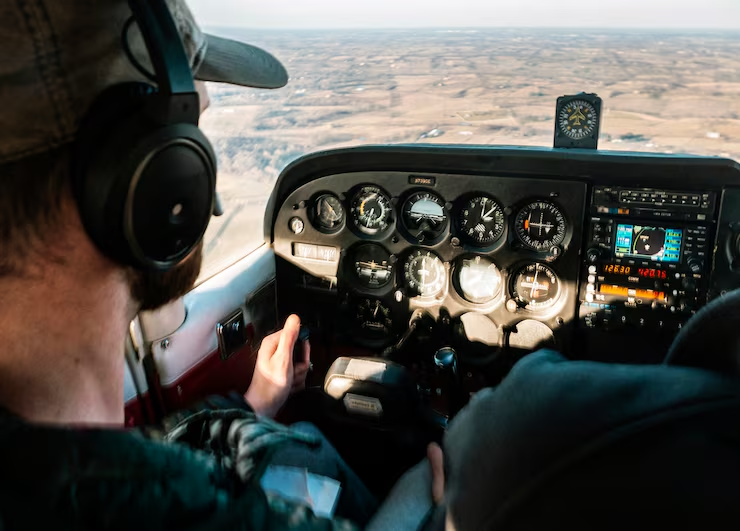
For decades, flight schools operated under the same inertia: the well-known local instructor, a sign at the airfield, and word-of-mouth recommendations from students. That system worked when local competition was low and operating margins were comfortable. Today, with high operational costs and aircraft demanding constant maintenance, waiting for the phone to ring is a risky bet.
The schools that consistently fill their courses and keep their aircraft in the air do not necessarily have better planes: they have a digital system that attracts, nurtures, and converts students predictably.
1. The Pitfall of Relying Solely on Word-of-Mouth
Word-of-mouth is great, but it has an invisible ceiling: it is entirely passive. You cannot forecast how many students you will have next quarter if you rely on someone recommending you at a dinner party. Aeronautical digital marketing doesn't break traditional trust; it multiplies it. It puts your flight school right in front of the person sitting at home searching Google on how to start flying, long before they encounter your competition.
2. What Future Pilots Are Actually Looking For
The most common mistake schools make online is using complex technical jargon right away or, conversely, leaving their website empty with an outdated PDF price list. Someone wanting to become a pilot goes through three clear stages before setting foot in a hangar:
- Initial Doubt: They want to know if the medical exam is as hard as they say, how long it takes, and what legal requirements are needed.
- Comparison: They compare total costs, airfield location, fleet condition (modern aircraft vs. decades-old trainers), and instructor experience.
- Decision: They need a fast, frictionless channel to book an introductory discovery flight or an in-person meeting.
Your digital content and website must surgically answer these three stages.
3. The Anatomy of a High-Converting Landing Page
A generic five-tab corporate website won't drive conversions. To capture students, you need specific landing pages for each goal: one for the Private Pilot License (PPL), another for Commercial Pilot (CPL), and another focused exclusively on discovery flights or recreational experiences.
That page must display what a student needs to see to trust you: real photos of your fleet (no generic stock images), names of your chief instructors, verified reviews from graduated students, and a direct form or WhatsApp button.
4. Response Speed: The Invisible Filter
This is where 80% of flight schools burn money on ads. A prospect fills out a form on a Tuesday at 7:00 PM asking about license requirements. If the school replies by Thursday afternoon, that prospect has already checked three other clubs and enrolled elsewhere.
Response speed is a flight school's most critical commercial asset. Automating the initial greeting, sending the cost brochure, and proposing a call or visit separates a fully booked school from one struggling month to month.
5. Predictability: Consistent Flight Hours
The goal of structuring this process isn't to have one overloaded month followed by two dead ones. Aircraft maintenance costs don't pause just because there are no students; therefore, cash flow must remain steady. A properly calibrated digital system lets you scale ad spend according to your actual aircraft availability and instructor capacity.
Frequently Asked Questions
Is it better to promote the Private Pilot License or the discovery flight? It depends on your business model. Discovery flights generate quick cash flow and bring people to the airfield; PPL or CPL courses are long-term, higher-margin businesses. Ideally, structure separate funnels for both objectives.
Do Instagram and TikTok ads work for getting students? Yes, but with nuances. Instagram and TikTok work great emotionally (cockpits, sunset flights, student solos) to generate desire. However, when users are ready to invest significant money into a costly course, they usually turn to Google to research and compare schools. That is why the combination of Social Media + SEO + Google Ads is lethal.
What budget do I need to start running campaigns? Less than the cost of a major engine overhaul. The goal isn't to burn money on empty impressions, but to target geographically (e.g., a 50 km radius around your airfield) so every dollar reaches local prospects who can actually visit your facility.